The web used to look like you.
Half my high school year taught itself to code customising MySpace pages. That freedom never had to disappear, and for about the price of two coffees a year you can have it back on a domain no one can switch off.
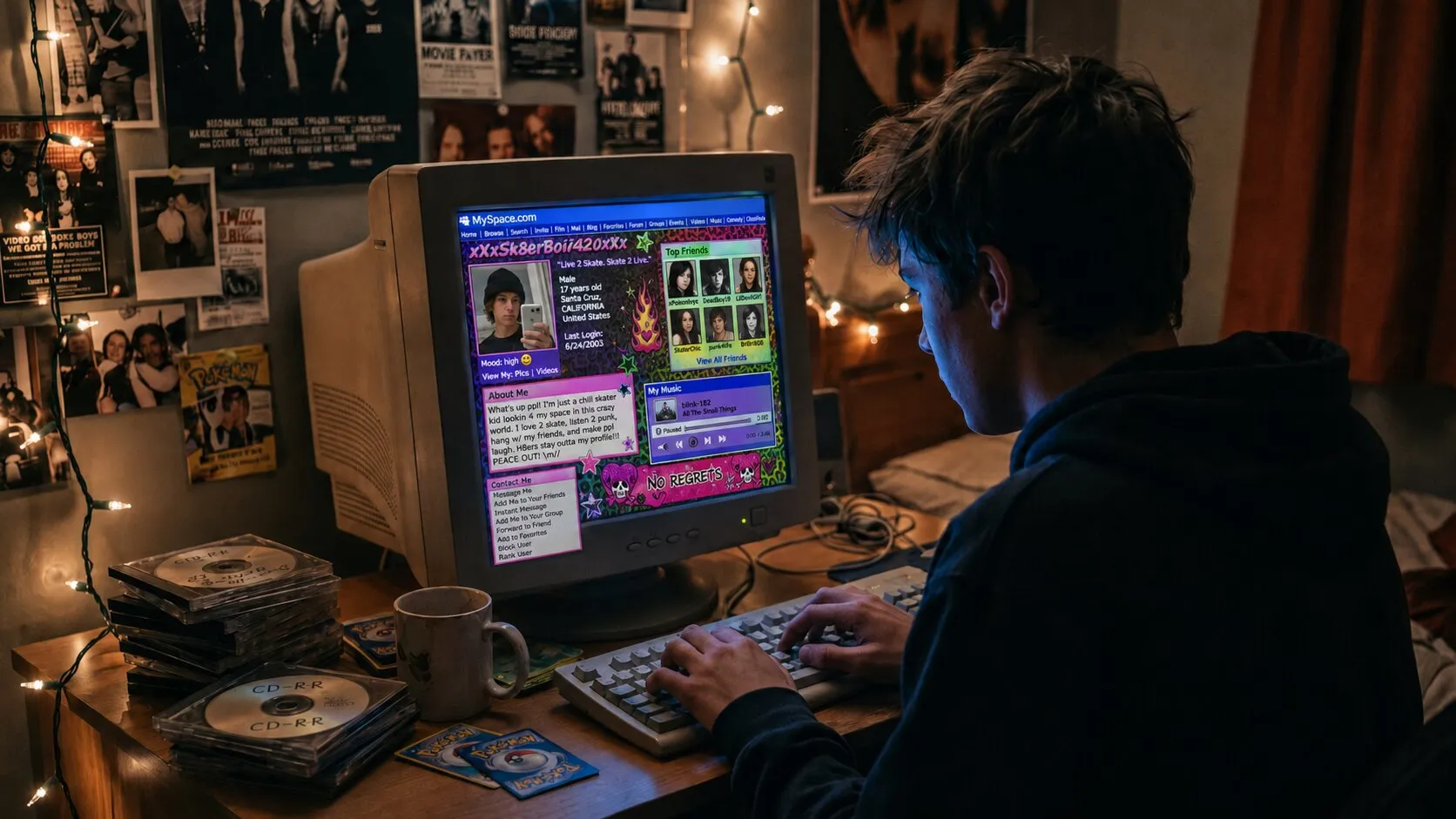
There was a year, around 2007, when half my year level taught themselves to code. Nobody called it that. We called it 'doing your MySpace'.
It started with one kid whose profile looked nothing like everyone else's. A custom background, a cursor that trailed sparkles behind it, a song that auto-played the second the page loaded, lyrics set in a font you had to lean in to read. By the next week three more people had it. Then it was an arms race. You traded snippets in the playground the way you'd traded Pokemon cards the year before, except these snippets were CSS and you had no idea that was the word for them. You pasted them into a box, watched your whole layout fall over, and spent the afternoon hunting for the closing tag you'd missed. Mine was a shrine to whatever band I loved that month, with a contact table that was, in hindsight, an accessibility crime. I was proud of it in a way I have rarely been proud of anything since.
It was fiddlier than anything we do on social media now. Setting up an Instagram profile is a form. This was raw HTML and CSS, pasted into the wrong fields, debugged by feel, with nothing on the screen to tell you what you'd broken or why. The part I only understood much later: none of it was meant to happen. MySpace's developers, by their own account, simply failed to stop users adding their own HTML and CSS. People loved the accident so much that it stayed. Codecademy later called those profiles likely the most widely accessible coding tutorials available to the general public at the time. A generation learned to code by mistake, on a platform that never set out to teach them anything.
What the freedom was, and why it died.
The freedom was specific. You could edit the raw page. Not pick a theme, not choose from twelve approved colours, but reach into the page's own code and change anything at all, down to the shape of the cursor. That is a different kind of thing from anything a feed hands you now. It felt less like decorating a room and more like building one.
Then it went the way these things go. News Corp bought MySpace in 2005 for US$580 million, a number that felt, at the time, like proof the thing would last forever. For a while it was everywhere. Then Facebook arrived with the opposite pitch to the playground arms race: every profile identical and clean, no broken tables, no song ambushing you when the page loaded. People left. MySpace tidied itself up to compete, and somewhere in the tidying it switched off the custom HTML that had made it what it was. A few years on it sold for around US$35 million. The same thing, worth a fraction of what someone had once paid, stripped of the very mess that people had loved. The expressive, slightly broken web got smoothed into uniform feeds, the feeds got sorted by algorithms, and the thing we had taught ourselves to do had nowhere left to go.
I don't want to over-romanticise the loss.
But something real did go missing: the page was yours, and it looked like you.
The same feeling, a different tool.
I felt the exact playground feeling again recently, and it took me a while to place where I knew it from. It was watching ordinary people, people who would never call themselves technical, suddenly able to make things with AI.
It is not a niche thing. Building software by describing it in plain language even has a name now, vibe coding, which was Collins Dictionary's Word of the Year for 2025. But the numbers were never the part that moved me. It was the look on a friend's face when the thing he had described out loud actually ran. The same delight, the same slightly stunned pride, that used to come off a kid in the playground showing you a sparkle cursor he had no business knowing how to make.
The grown-up version of the same urge.
That itch to make something of your own needs somewhere to live. The adult form of 'doing your MySpace' is owning your own domain, and there is a small movement built around exactly that.
The IndieWeb, which came together around 2011, calls itself a people-focused alternative to the corporate web, built on owning your domain and using it as your primary online identity and owning your content. Its working principle has an unlovely acronym, POSSE: Publish on your Own Site, Syndicate Elsewhere. You write on the page you control, then push copies out to LinkedIn or wherever the readers happen to be. The original lives somewhere no one else can switch off.
The reason that urge has sharpened lately has a name too, one Australia thought fitting enough to crown its word of the year. Enshittification, Cory Doctorow's word for the slow way platforms turn from good to users, to good to their business customers, to good only to themselves, was the Macquarie Dictionary's Word of the Year for 2024. Anyone who built an audience somewhere and then watched the reach get throttled knows the feeling in their stomach. You were building on rented land, as one writer put it, and the audience was never yours.
I am not claiming everyone is about to walk out on social media. They aren't, and I'm not predicting it. This is a smaller and more stubborn thing than that. It is a choice about who holds the keys to the place your work lives. And the old small web is stirring again: people are making their own pages, the way they did, for no reason other than that they want to.
How I actually did it.
So I built one. It is at cameroncarmody.com. Just my name on the door.
Here is the cost, because the cost is the part that still makes me grin. The domain runs about A$15 a year. Hosting is free, genuinely free, with no asterisk waiting to catch you on a busy month. The recurring price of a permanent home on the internet works out to roughly two coffees a year. That is the whole bill.
The build is where AI changed what was possible for someone like me, so let me be clear about the line between us. I decided what the site should be, what went on it, what it said and how it read. The machine did the typing. I used Claude Code, an AI coding tool that lives inside my editor and can see the whole project at once. I told it what I wanted, read back the changes it proposed, then saved them to a free code host called GitHub, and the site rebuilt and went live on its own, every time, with nothing to upload by hand. The judgement was mine. The repetitive, well-trodden code was the model's. That one division is the whole reason this became a weekend instead of half a year.
Owning a page wins you no audience, and it never did. That was never the point.
It is worth doing anyway. I taught myself a fragment of HTML at fifteen for a profile that no longer exists, on a platform that sold for scraps. Twenty years later the same itch has a permanent home. The page is mine, it cost less than a round of coffees, it looks like me, and the only person who can ever take it down is the one who built it.